

By Hidy Basta, Seattle University
As a transnational translingual academic, I’m used to spending an unfair share of emotional energy worrying whether I have missed a subject verb agreement somewhere, if that “error” would jeopardize my belonging—if it would undermine what I’ve written. I appreciate the helpful tools of my word processors—the swirly red lines signaling me to take another look. This is a technology I could trust even as I tend to dismiss a lot of its suggestions because I believe I’m intentional or perhaps just stubborn. I don’t think I would trust generative artificial intelligence (GenAI) to edit my writing: I prefer to have my written accent, to own my own words, to be grateful to the careful eyes of my trusted human editors and their refreshing sense of humor, and also to access water. I have the luxury of time, and I don’t mind spending it doing work I love. I acknowledge both my privilege and my internalized anxieties.
As the director of the writing center in my institution, my anxieties help me appreciate the concerns with which our clients consistently select “sentence level structure and grammar” as the highest priority for their writing center visit/use. My anxiety also helped me understand why there was much promise in the GenAI tools purporting to level the playing field for multilingual writers.
Historically, writing center practices undermined the concerns for grammar and mechanics as lower order concerns—far less important than the higher order of structure and organization. As we have benefited from the critical scholarship that applies linguistic justice to writing center practice (eg. Condon; Denny and Towle; Faison; Garcia; Grimm; Green; Greenfield, among many others), we’ve begun to acknowledge clients’ concerns for grammar and mechanics. However, this acknowledgment doesn’t lead to a predetermined decision to conform to Standard Academic English (SAE). We don’t know how to “correct” things. Instead, writing consultants often engage in meaning making conversations, encourage writers to own their agency, consider their rhetorical choices, and explore the possibilities, etc. It’s an uncertain and a time-consuming process. GenAI outputs do this process in split seconds—the conformity to language of power is not carefully considered or negotiated; it’s rather oppressively normalized. The outputs are efficiently decisive.

No wonder, the decisive conformity brought about by LLMs in programs like Grammarly, and ChatGPT, among others, seemed to respond more “efficiently” to students’ requests. As the MLA/CCC Joint Task Force on Writing and AI capture the advantages of the emerging technology as a way to level the playing field by promising “[w]riters who come from diverse and various linguistic and educational backgrounds [to] benefit from the more sophisticated grammar, style, and genre editing capabilities of LLMs by receiving access to the ‘language of power’” (MLA/CCCC, 2023, p.9). I was surprised that I found no comfort in this purported promise—not as a translingual writer, not as a writing center administrator, and not as a writing instructor. The statement of purported benefit echoes standard language ideology in assuming that the “language of power” is actually “more sophisticated” than the linguistic resources of the language diversity and linguistic backgrounds. Linguistic justice is not the same as linguistic access, and we shouldn’t confuse the two in our practice.
In her book, Linguistic Justice: Black Language, Literacy, Identity and Pedagogy, April Baker-Bell explains that “[linguistic justice] is about dismantling Anti-Black Linguistic Racism and white linguistic hegemony and supremacy in classrooms and in the world” (7). Linguistic justice is about linguistic human rights. It’s about Students’ Right to Their Own Language. It’s about Black Linguistic Justice. I seriously doubt that GenAI can level the playing field any more than the adherence to standard academic English (SAE) does. Indeed, the similarities in the failure of both to achieve linguistic justice are striking.
Both (1) normalize language dominance, (2) make translingual and racialized writers seem suspect, and (3) use self-fulfilling inevitability arguments limiting the legitimacy of more linguistically just frameworks.
(1) Normalization of Language Dominance
In her chapter, “The ‘Standard English’ Fairy Tale: A Rhetorical Analysis of Racist Pedagogies and Commonplace Assumptions about Language Diversity” Laura Greenfield reminds us that standard language is an idealized and imagined version that approximates the language of the privileged, often white, hetero, middle class, and male speakers. The idealized standardized version is often replicated to give logic to the unjustifiable oppression of the racialized speakers. Julia Lee and colleagues describe the ways in which large language models are trained in large data sets that are representative mostly of privileged standard English which further normalizes its dominance and marginalizes different varieties. The ubiquity of the standardized/white linguistic features, styles, genres come to represent the legitimate discourse of academic writing and in doing so dismisses marginalized varieties. A good example is Alfred Owusu-Ansah’s exploration of the ways in which GenAI reflected standard language ideology when it told him that “while it is possible to write an academic paper in Ghanaian English, it is important to use standard English grammar” (144). When further prompted to use Ghanaian English, the output was a fictionalized stereotyped pidgin. Owusu-Ansah demonstrates how GenAI tools are trained to echo the colonialist language ideology that privileges white and western varieties while dismissing others.
(2) Racialized and Translingual Writers are Made Suspect
Even when translingual and multidialectal speakers perform assimilation, their linguistic production is often suspect. Greenfield cites several instances where racialized writers who wrote “perfect” English were often suspected of plagiarism. To be clear, I don’t mean to suggest that racialized and translingual writers can’t or shouldn’t claim standard English as their own. I mean to assert that even doing so is no guarantee of acceptance of their legitimacy. Greenfield argues that the skepticism grounded in SAE ideology doesn’t make space for bilingual/bidialectal speakers to be proficient in SAE as well as their home language. Their performance in standard English is “not viewed as bilingual but as a contradiction (53, emphasis in original). I believe the same mechanism works in using GenAI tools. Multilingual students’ texts are more scrutinized as demonstrated in several studies among which “Who Wrote This Essay?” Plagiarism deduction programs are known to also falsely flag translingual writers for plagiarism. Further, even the transparency and disclosure of GenAI use don’t always earn the trust of the evaluator/readers. One study on GenAI use on second language writing found that even when GenAI use is clearly disclosed by students, evaluators tended to score the essays that disclosed the use of GenAI lower due to multiple factors, among which is that the use hides the writers’ actual language proficiency. Perhaps the saying should go “it’s not how you write, it’s who you are.” Neither the adherence to SAE nor the use of GenAI to facilitate such adherence seem to bypass linguistic prejudice.
I have no doubt that the emerging technology of GenAI plays and will play a role in the future of writing, but it won’t bring about justice. Justice is about questioning the attitudes we hold on language diversity. If educators are so offended by students’ use of GenAI to replace their “authentic” language, then students shouldn’t be penalized for their authentic language in their assessment. If educators are offended by students’ use of GenAI in favor of producing a polished text that masks their messy learning process, then they should reward the learning process and make it more visible. If adherence to the monolingual polish of academic English is preferred, then assistive technology should be allowed (with a focus on educating students on documenting their rights to their intellectual properties).
(3) Racialized and Translingual Writers are Pressured to Adopt the Inevitability Argument for both Standard Academic English and GenAI
As SAE is peddled as the language of successful communication and GenAI tools as the future of writing, students often find little space to question the inevitability argument and to cherish their own voices in academic spaces. When I asked my first-year composition students to define what academic writing is on a shared padlet, they agreed that academic writing was something that is very different from what they do—a way to alienate them from their own voice.
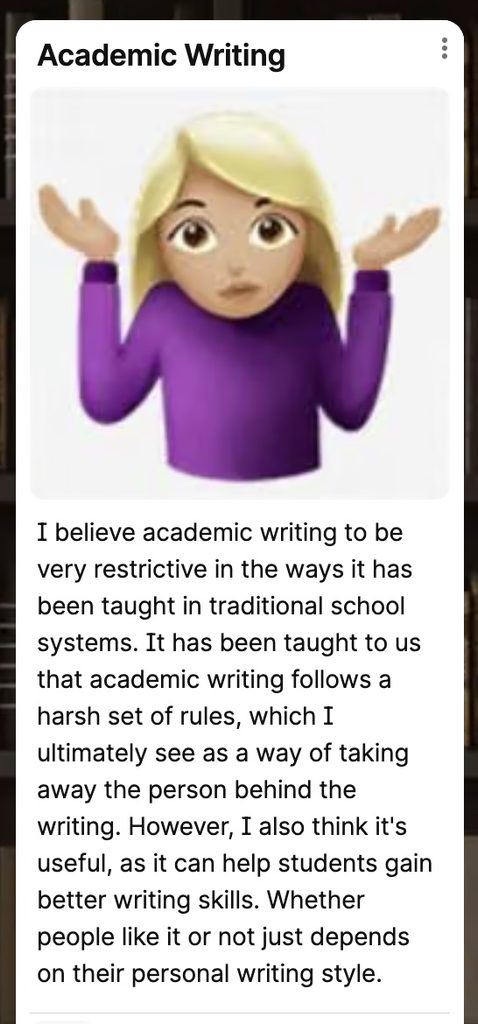
With the emoji of “I don’t know”—one of the most “liked” entries on the padlet was from a student who wrote “I believe academic writing to be very restrictive in the ways it has been taught in traditional school systems. It has been taught to us that academic writing follows a harsh set of rules, which I ultimately see as a way of taking away the person behind the writing. However, I also think it’s useful, as it can help students gain better writing skills. Whether people like it or not just depends on their personal writing style” (emphasis added). What struck me about this comment is the ways in which the writer (and most of the class) had unquestionably accepted what Bethany Davila describes as The Inevitability of “Standard” English, despite acknowledging the ideological conventional tradition, the violence in the harshness, the alienation of the writer, and the exclusion of those who have a different “personal” writing style. Davila’s study indicates that the standard edited language ideology is supported by discourses that promote it as “normal,” “natural,” “not-interfering,” and “widely accessible.” She proposes changes in the ways we discuss SAE, and purposefully using strategies implementing translingual strategies such as code-meshing (see Vershawn Ashanti Young’s “Should Writers Use They Own English”). Translingual writing, rhetorical grammar, critical language awareness are pedagogies that are often practiced in writing centers toward linguistic justice.
The use of GenAI in writing is often considered inevitable as well. Indeed, the argument for teaching GenAI literacy, much like the teaching of SAE, is about what future employers expect and require. While I understand the importance of teaching critical GenAI literacy in writing, I continue to be troubled by the assumption that the use of GenAI is the future of professional accomplishments. Perhaps it is, but it shouldn’t come at the cost of linguistic self-denial. Examining case studies of GenAI use in professional settings shows that it’s not a good replacement for linguistic justice and translingual approaches to communication. In her study, “Article laundry” or “tutor in pocket?, Qianqian Zhang-Wu examines a case study of multilingual writers’ generative AI-assisted writing in professional settings. She analyzes the case of Cara, a successful intern who was able to use GenAI tools brilliantly to accomplish her tasks during her virtual workdays. Her in-office days, however, brought a different experience of isolation. Cara didn’t feel comfortable using GenAI tools in the office. She didn’t feel comfortable hanging around with colleagues for fear that her language proficiency in English would be judged. She agonized over her decision to record the virtual meetings in order to take good notes. She was successful even exemplary by her internship criteria. The personal cost was social isolation and ethically questionable behaviors that troubled her. I wonder what if a linguistic justice framework was in place. What if Cara felt free to ask her colleagues permission for recording their fast-paced meetings? What if she felt comfortable asking for clarification, for time, for understanding and linguistic negotiation, or even for permission to use assistive GenAI tools? Why do successful professionals like Cara feel obligated to behave monolingually in their multilingual realities? In Cara’s case, both standard language ideology and GenAI tools led to a distrust of her own voice, proficiency, and belonging.
A linguistically just context is one in which people in academic and professional settings feel confident in negotiating their linguistic resources and identities? “[C]ultivating… a sense of agency in combating, linguistically and otherwise, the injustices that they encounter along the way” (Greenfield, 58) should be the goal of writing support. In my world, this context is the writing center. Writing centers can play an essential role in addressing the “crisis” uncovered by the rise of GenAI. I’m strangely optimistic because the emerging technology brings us to truly question what we should teach and what we should value.
There is much exciting work for the writing center to do.
The writing center practice could be the perfect antidote to the hegemony of standard language ideology that is otherwise normalized by the instantaneous outputs of GenAI. The writing center practice resists what Paul Matsuda calls the myth of linguistic homogeneity. By taking the time to deliberate with the client on the rhetorical options, the writing center supports students’ agency and respects their linguistic resources which don’t need to be sacrificed on the altar of “correctness.” The time-consuming back and forth during a consultation offers much needed space to explore and negotiate multiple possibilities. The practice cares that the writer is making an intentional choice rather than simply defaulting to excluding their linguistic resources and reproducing the standardized version. Linguistic justice is about dismantling language hegemony and language supremacy. The messy, slow, collaborative, and creative process in a writing conversation goes a long way toward dismantling what long has been normalized.
For our work, I believe this means that:
- We need to continue to push back against our historical stubborn refusal to address grammar issues as “lower order concerns.” Actually, while we are at it, we should stop labeling any concern a client brings to a session as “lower anything.” Even when misplaced, students’ anxieties and questions should be honored. The consultants at the writing center where I work are comfortable addressing grammar and sentence structure rhetorically. They are not reluctant to spend time exploring the intended meaning and the options available to the writer. The decision-making process is flexible, context-sensitive, and intentional. Unlike GenAI tools that tend to be more assertive toward minoritized writers in its “individualized” peer feedback, writing consultants focus on supporting the writer’s agency in learning additional options and making decisions rather than defaulting to the “hidden curriculum.”
- Expand our work to invite our campus community and indeed academic communities to appreciate the linguistic diversity as the rich linguistic resource it is. The rise of GenAI has offered an opportunity to re-examine the long held beliefs about writing and assessment. It is refreshing to see colleagues question the traditional rubrics and place more value on the writing process and on student voice. The recently published collection, Writing Centers and AI: Generating Early Conversations offers a valuable and practical guide on how a writing center could help navigate the nuanced discussions.
- Seek transparency in GenAI policy creation and implementation. Our community at the Seattle University Writing Center was aware of the ways in which students’ confusion and anxieties over what’s considered an ethical and responsible use of GenAI and what can land them in an academic integrity proceeding was affecting their decision and comfort in using the emerging technologies. We understood the vulnerability that the writers experienced and we wanted the writing center to be a place where we can discuss concerns and questions. In our team meetings and workshops, we familiarized ourselves with the Seattle University updated Academic Integrity Policy, shared resources, and workshopped scenarios to support our day-to-day practice. Theoretically, we felt reasonably assured, in reality we struggled and our limited policy of focusing on academic integrity principles, ensuring appropriate documentation of sources, ensuring adherence to course policies, etc. fell short. We needed more space to co-design a policy that included our collective experiences and the multiple perspectives of our clients and campus community. Allowing respectful space for both the refusal to adopt GenAI tools and excitement for the possibilities they could offer seemed a bit odd but ultimately necessary. Our policies matter and who gets to set them up matter as well. Policy co-design frameworks seek to include those who are always affected by the policies that they rarely get to shape. Inspired by the research of Michael Mintrom and colleagues on how the principles of co-design could inform public policies and following the Design Justice Network Principles, we started an exciting, long, and often messy project aiming to co-design a GenAI policy that is informed by the community. We envision the policy as a living document, always responsive to our emerging knowledge and our community’s experience.
While GenAI tools don’t form a solid path toward linguistic justice, the discussions and policies on their use offer renewed opportunities to rethink what we value and to critically reflect on our practice. Is our practice truly the antidote to the failure of SAE and GenAI tools in supporting linguistic justice? With each writing consultation, we can refuse to normalize language dominance by honoring students’ identities, linguistic resources, and ways of knowing. Each encounter can offer a trusting environment where racialized and translingual writers can freely practice multiple ways of effectively engaging in academic discourses. And each encounter has the potential to resist the pressure to buy into inevitability arguments. My hope is that as we critically reflect on how our practices can work better toward linguistic justice, we would value (even more) the very messy, vulnerable, collaborative, and rewarding process of enacting our agency as writers and readers navigating our belonging in translingual realities.

Hidy Basta received her Ph.D. in Language and Rhetoric from the University of Washington. She is an Assistant Professor of English and Writing Center Director at Seattle University, Seattle, Washington. Her research and teaching interests include language ideology and policy, multilingual identity, linguistic justice, and narrative analysis. Her recent research and teaching focus on writing consultants’ education toward social justice and trauma-informed pedagogy.