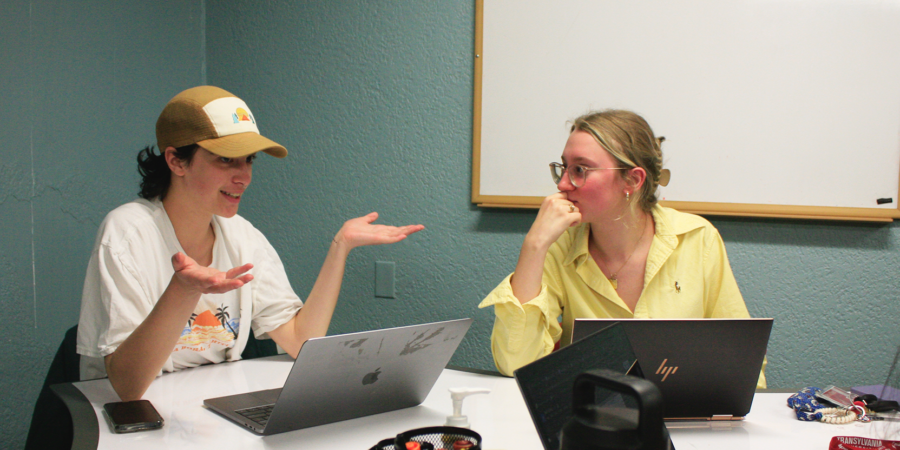
Finding Universal Design for Learning in Your “Tough” Tutoring Session
By Anmol Sahni, Emory University
By Tisha Turk, Grinnell College—In recent years, attention has come in for a lot of, well, attention. Scholars, journalists, and cultural critics have written about how corporations capture and monetize the finite resource of our attention and, sometimes, how we can regain control of it (Wu; Odell; Hari; Hayes). Those of us working in institutions of higher ed have probably observed the effects of attention capture not only on ourselves but on our students. My observations about attention are not […]
By Sam Hyatt and Meg Hultgren, University of South Carolina—As doctoral students serving as Assistant Directors (ADs) in the Writing Center (WC) at the University of South Carolina during uncertain academic times, we’ve had the unique opportunity to navigate leadership roles while still actively engaged in graduate study. Our tutoring staff is also distinctive—comprised entirely of English graduate students, primarily MAs and MFAs in their first year of school—which has shaped the collaborative and academic culture within our center. // Our overlapping roles as students, tutors, and leaders has been both challenging and rewarding, […]
By Eve Brunell, Estella Davis, Jay Fowler, Caroline Host, Dylan Howell, Emily Jackson, Olivia Jackson, Evan Paden, Olivia Sparks, Ellie Thornsbury, Erika Williams (under the direction of Dr. Scott Whiddon, Transylvania University)—In Fall 2023, Transylvania University Writing Center (TUWC) partnered with four undergraduate courses—theater, philosophy, sociology, and writing/rhetoric/communication—to support writers working within a range of genres and assignment types. In each of these partnerships, enrolled students were required to work with a TUWC undergraduate peer writing consultant at least two times to support understanding prompts, brainstorming possible pathways, developing drafts, and considering revision strategies. […]
By Elizabeth Parfitt, Penn State University—As a writing center administrator, I observe 15-20 new writing tutors each semester to provide them with constructive feedback toward their development as tutors, scholars, and writers. […] It’s a part of my job that is time consuming but a highlight. When I’m sitting next to a writer and tutor, watching them move an idea forward, I feel connected to the writing center and the possibilities that tutoring affords. I feel confident that the work we’re doing is making a difference on campus. This overt emotional connection to the work might also explain why I honed in on a curious trend during my observations this past year. […]
By Daniella Peinado, Dava Newell, Lisa Diethelm, and Jessica Jones—Supporting students’ writing online has been a topic of conversation in writing centers for decades. Muriel Harris discussed incorporating technology into writing centers in 2000, and in 2009, Neaderhiser and Wolfe reviewed ways writing centers were using new technology tools to support writing centers. The Academic Support Network (ASN) at Arizona State University (ASU) has developed a dual-modality tutoring model which taught us how to identify our core goals for supporting student’s writing to then use available technologies to adapt and meet those goals. […]
By Marina De Greef, Tobi Jacobi, and Sarah Neve—Writing Tip of the Day: Map out which writing tasks you can accomplish before each port to make upcoming port/class turnarounds manageable. Gather a few sources and make an outline or commit to writing a few paragraphs before stepping off the ship (Dean’s memo, March 16, 2023). Writing centers have a storied history as shape shifters, […]
A conversation with Grace Apostol, Miranda Parrish, and Rachel Rodriguez, Washington College—How do writing tutors navigate difficult conversations in the course of their work with peers, moments where student writers share vulnerabilities or tutors feel the heavy weight of imposter syndrome? Washington College writing center director Rachel Rodriguez facilitates a conversation with two undergraduate writing tutors, Grace Apostol and Miranda Parrish, about how they grapple with these scenarios and translate their training into the reality of their praxis. […]
By Holly Berkowitz, University of Tennessee at Chattanooga–There is a widespread perception that TikTok, the popular video-sharing social media platform, is primarily a tool of distraction where one mindlessly scrolls through bite-sized bits of content. However, due to the viewer’s ability to engage with short-form video content, it is undeniable that TikTok is also a platform from which users gain information; whether this means following a viral dance tutorial or learning how to fold a fitted sheet, TikTok houses millions of videos that serve as instructional tutorials that provides tips or how-tos for its over one billion active users. […]
By Thomas Deans, Noah Praver, and Alexander Solod, University of Connecticut—Even those far from college writing programs are talking more about writing these days, and we all know why: AI. Some disciplinary associations, including CCCC, MLA, and AWAC, have formed task forces on AI, posted working papers, or issued position statements (nothing yet from IWCA). Some writing centers have started creating materials to guide tutors. And all of us will be mulling over how to handle […]